
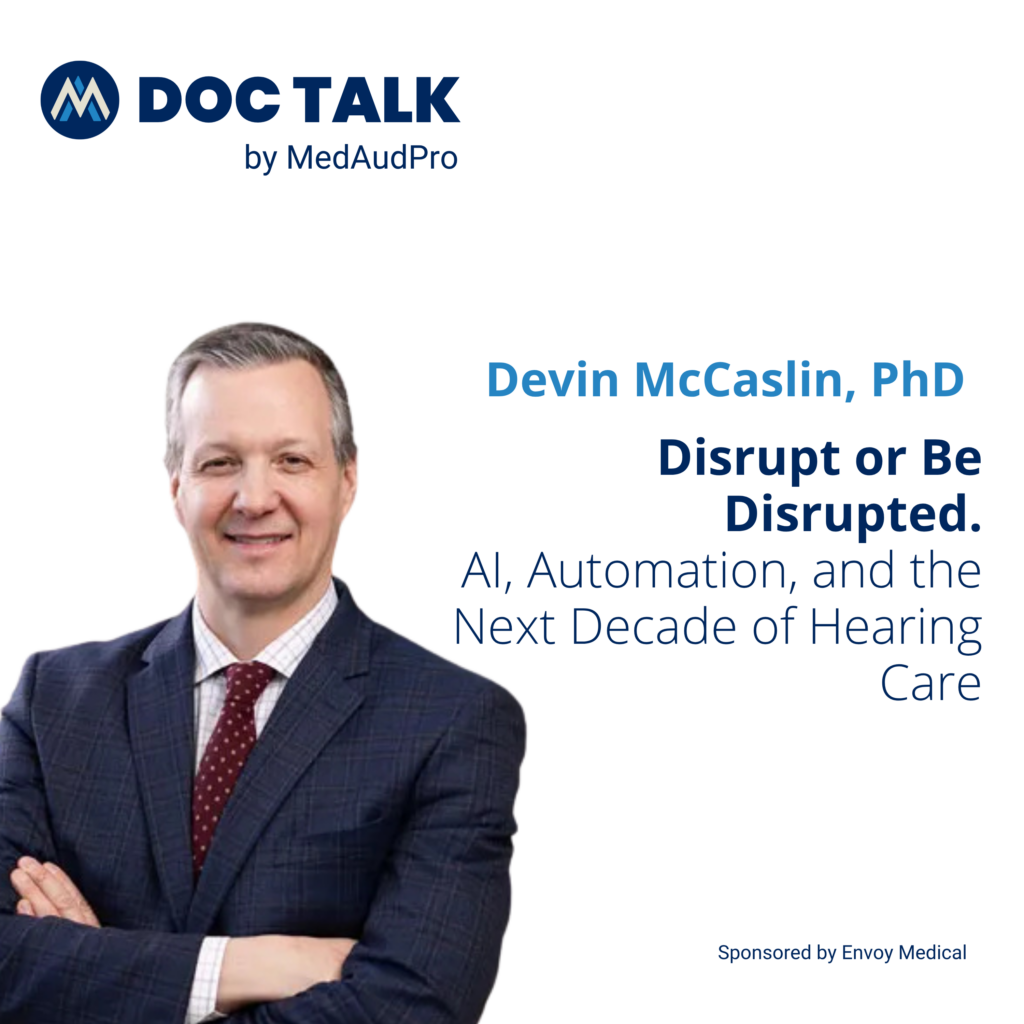
Artificial intelligence is already influencing hearing healthcare, but the biggest changes may have less to do with replacing clinicians and more to do with how patients move through the system, how data is used, and how care teams make decisions.
Meet Devin McCaslin, PhD, Clinical Director of Communication Sciences and Disorders at Michigan Medicine and a professor in Otolaryngology and Biomedical Engineering at the University of Michigan. His work sits at the intersection of audiology, vestibular care, engineering, and artificial intelligence. He and his collaborators are developing AI-supported approaches to triage, data integration, clinical decision support, and the future design of hearing healthcare.
What You’ll Hear:
What AI Can Actually Do Today: Where artificial intelligence is already being used in healthcare, including triage, workflow efficiency, decision support, and reducing variability in how patients move through complex systems.
From Models to AI Agents: Why the next step goes beyond predicting what might happen. AI agents may be able to identify patients, verify missing information, support referrals, monitor outcomes, and complete tasks across multiple systems.
Finding Cochlear Implant Candidates Earlier: How structured data and AI could help identify patients who may qualify for cochlear implantation before they are lost in the referral pathway.
The Learning Health System: Why McCaslin believes healthcare is moving toward systems where every patient encounter contributes data that can improve decisions for the next patient.
The Data Problem: Why artificial intelligence is only as useful as the information behind it, and why audiology programs need to think differently about how they structure, capture, and control their clinical data.
Building the Right Team: Why future innovation in audiology may require partnerships with AI engineers, operations engineers, biomedical engineers, and other professionals who bring completely different perspectives to longstanding clinical problems.
What Happens to the Audiologist?: As AI becomes better at pattern recognition, diagnostics, and routine tasks, the audiologist’s value may increasingly center on interpretation, critical thinking, counseling, communication, and helping patients make informed decisions.
The Business Model Will Have to Change: Why greater efficiency does not automatically solve the question of how clinicians are compensated for the counseling, rehabilitation, and decision-making that become even more important in an AI-supported healthcare system.
Preparing for What Comes Next: Why healthcare organizations that invest in people, data infrastructure, engineering resources, and internal champions may be better positioned to adapt than those waiting for new technology to simply arrive.
McCaslin’s message is not that AI is going to replace audiologists. It is that the infrastructure around audiology is changing quickly, and clinicians need to understand enough about these technologies to participate in shaping how they are used.
For cochlear implant and medical audiology programs, that creates an important question: Are we preparing our systems, our data, and our teams for where healthcare is going, or are we still designing care around the way it has always been delivered?
Who should listen?
Audiologists, otologists, neurotologists, cochlear implant teams, vestibular specialists, hearing healthcare professionals, program directors, clinic managers, hospital administrators, researchers, students, and anyone interested in how artificial intelligence may change the delivery of medical audiology.
Stay up to date with us on LinkedIn, Facebook, and Instagram @MedAudPro.
Want to learn more about FCOM?
Join the MedAudPro Provider Community: