
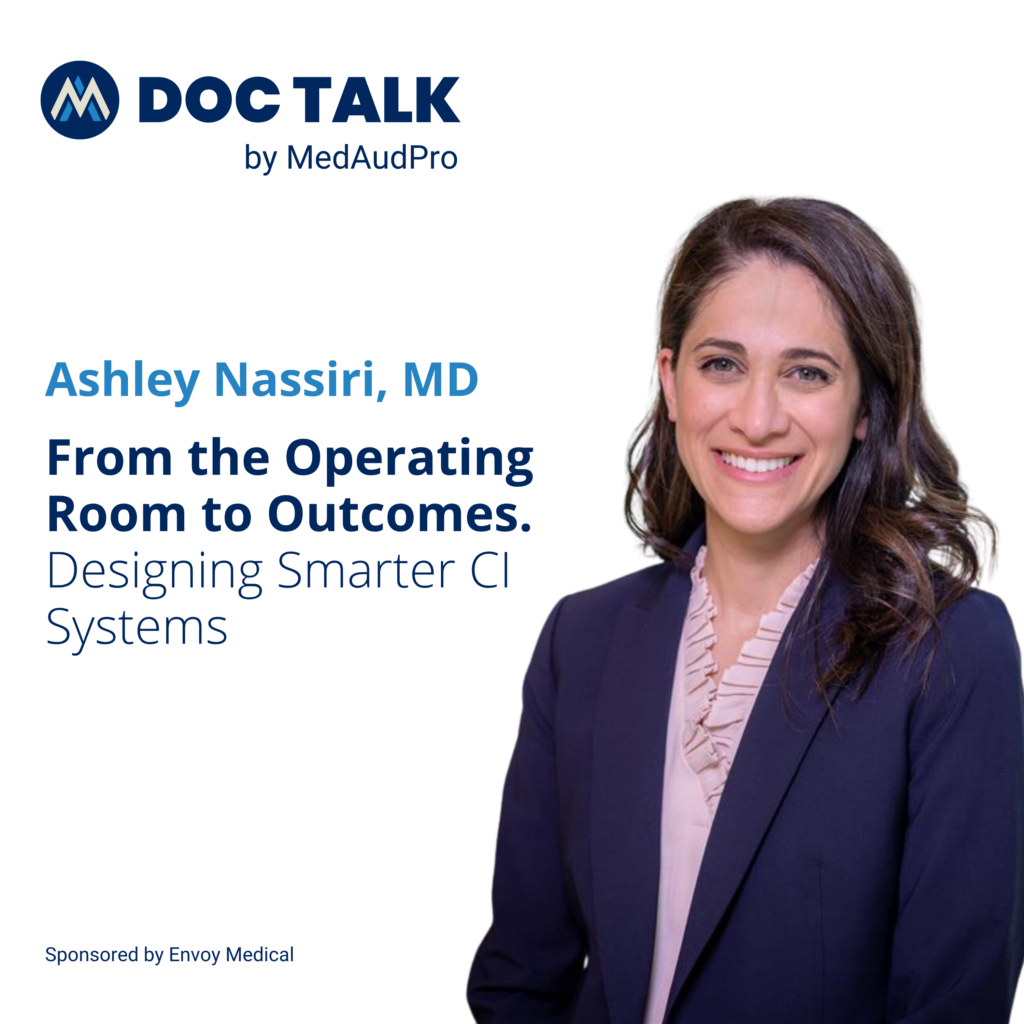
Cochlear implantation has advanced dramatically, but getting the right patient from hearing loss to evaluation, surgery, activation, and long-term care can still be unnecessarily complicated. As candidacy expands and demand grows, the question is not simply how to see more patients. It is how to design a smarter system around them.
Meet Ashley Nassiri, MD, MBA, a fellowship-trained neurotologist and skull base surgeon at the University of Colorado School of Medicine, where she serves as Director of the Cochlear Implant Program. Her work examines cochlear implant access, utilization, surgical care, and new models of care delivery. With training in both medicine and business, Dr. Nassiri brings a broader perspective to how CI programs can improve access, efficiency, and outcomes.
What You’ll Hear:
Thinking Beyond the Procedure: Why successful cochlear implant care depends on much more than what happens in the operating room.
The Access Problem: Why cochlear implant utilization remains low despite broader candidacy and greater awareness, and where patients can get lost along the way.
Rethinking the Traditional Pathway: How long-standing workflows may create unnecessary delays, visits, and barriers for patients.
Designing Care Around the Patient: Why programs should evaluate which parts of the pathway truly require separate appointments and which can be coordinated differently.
New Models of Care: What same-day consultation and surgery, telemedicine, remote programming, and digital education can teach us about improving CI delivery.
Using the Right Resource at the Right Time: Why every part of CI care does not need to happen in the same place, with the same provider, or through the same type of visit.
The Surgeon’s Role in System Design: Why physicians need to think beyond surgery and understand the operational barriers that affect whether patients reach implantation and receive appropriate follow-up.
Technology Is Only Part of the Answer: Why remote tools can improve access, but only when they are part of a thoughtful clinical model.
Measuring What Matters: Why programs should look beyond visit volume and focus on patient experience, access, clinical outcomes, and the use of limited healthcare resources.
Dr. Nassiri makes the case for viewing cochlear implant care as one connected system rather than a series of individual appointments. Improving access does not mean sacrificing quality or simply asking clinicians to work faster. It means identifying where the current pathway creates friction and redesigning care more intentionally.
Who should listen?
Audiologists, otologists, neurotologists, cochlear implant teams, hearing healthcare professionals, program directors, clinic managers, hospital administrators, private practice owners, students, residents, fellows, researchers, and anyone working to improve access and outcomes in cochlear implant care.
If your CI program is growing or operating largely the same way it has for years, this episode asks an important question: Are we optimizing individual parts of cochlear implant care, or are we designing a better system from beginning to end?
Stay up to date with us on LinkedIn, Facebook, and Instagram @MedAudPro.
Want to learn more about FCOM?
Join the MedAudPro Provider Community:
This episode is sponsored by Envoy Medical.